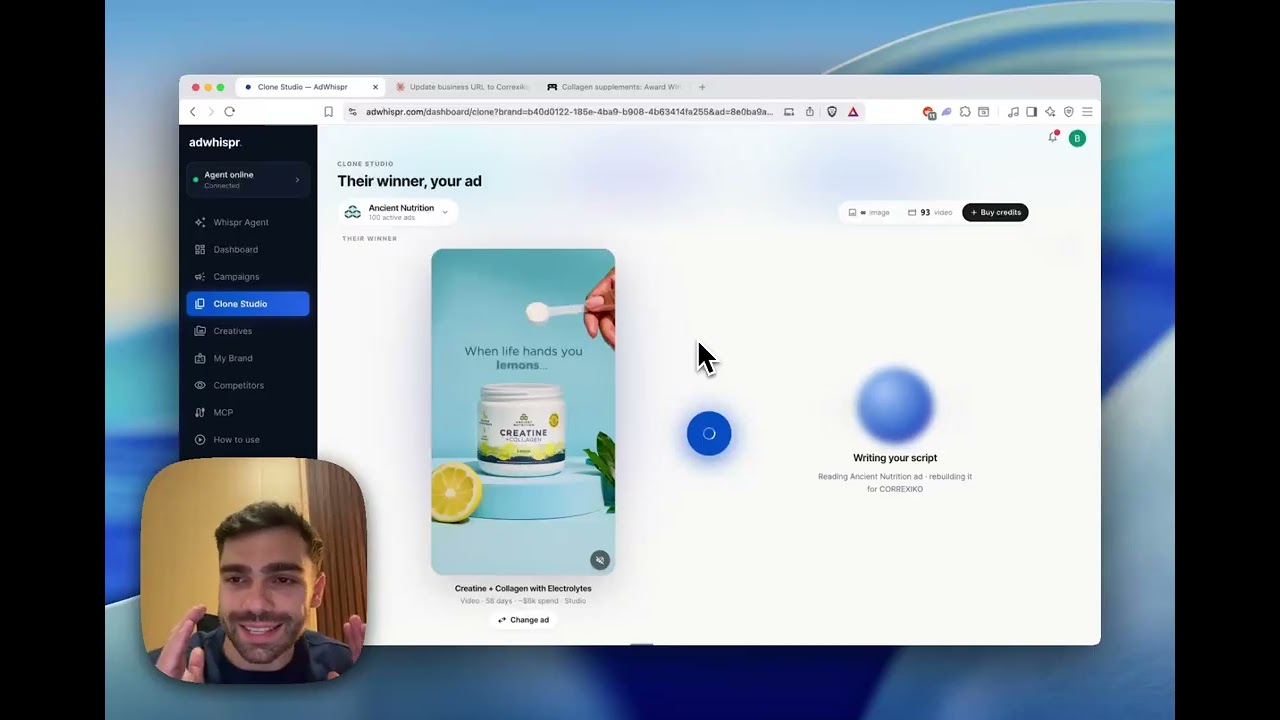

The point of competitor research is not to see what a rival is advertising. It is to see what is working. Those are different questions, and the second one has a surprisingly simple answer.
Step 1: Pick a real competitor
Choose a brand that actually runs paid ads. A competitor with no live ads gives you nothing to learn from.
If you are not sure who advertises in your space, ask the assistant instead of guessing:
Who are my competitors and which of them are running ads right now?
AdWhispr checks which brands are genuinely advertising at that moment, rather than listing names from memory. That distinction matters, because a plausible-sounding competitor who does not buy ads is a dead end.
Step 2: Add the brand
Paste the competitor's Facebook page URL, or ask by name:
Add Gymshark and show me their ads.
The first ingest pulls their entire ad library, not a sample. For an active brand that can be a few hundred ads, and it usually takes under a minute. Enrichment continues in the background, so you can start asking questions before it finishes.
Step 3: Find the winner, not the newest
This is the question that matters:
What is their longest-running ad right now?
An ad still live after four months survived four months of someone with budget deciding, repeatedly, not to switch it off. The newest, glossiest creative in the library has passed no such test. It might be dead by Friday.
Follow it with the question that turns one data point into a strategy:
Show me every ad they have had live over 90 days, and tell me what those ads have in common.
If several long-runners share a hook, a format and an offer shape, you have found their formula. That pattern is the actual output of a research session.
Step 4: Read the distribution
One more question, and this is the one most people never ask:
How many of their ads are under 30 days, 30 to 90, and over 90?
A brand with fifteen ads past 90 days has found something durable and is scaling it. A brand whose oldest ad is 22 days is still testing and has not found a winner yet. Both are useful. The first tells you what to learn from, the second tells you the category is still open.
What not to expect
AdWhispr will not show you a competitor's CTR, CPC, ROAS or conversion count. Nobody can. Those numbers live inside the advertiser's own account and are never published. Any tool that shows you a rival's exact ROAS made the number up.
What you get instead is longevity, creative, format, hook, offer and how those change over time. That is real, verifiable, and enough to act on.
FAQ
How long does the first ingest take?
Usually under a minute for the ad library itself. AI classification of hooks and formats runs in the background afterwards, and you can ask questions while it finishes.
Can I track more than one competitor?
The free plan needs no credit card. Paid plans raise that limit. You can swap which brand you track at any time.
Does the competitor know I am looking?
No. Ad libraries are public by law. Meta publishes every active ad for transparency reasons, and reading that data is anonymous.
What if the brand has no ads?
Then they are not currently advertising on that platform, which is itself worth knowing. Ask which brands in your category are running ads and start with one of those instead.
Why does days-running matter more than the number of ads?
Volume tells you a brand has a budget. Longevity tells you something worked. A brand can run two hundred ads and kill all of them in a fortnight.